

Safety Note: Electrical troubleshooting should be performed only by qualified personnel using appropriate electrical safety procedures. Always follow applicable electrical codes, site requirements, and the documentation supplied with the equipment.
When a STEP (Septic Tank Effluent Pump) system isn’t operating as expected, the control panel is often one of the first places a technician looks. However, a problem that appears to be a control panel failure may actually originate somewhere else in the system.
Before replacing components or assuming the panel has failed (“throwing parts at it”), a systematic troubleshooting process can often help identify the problem quickly. This guide walks through that process in order, from the utility connection down to the discharge line, the same way Stepros technical support does it on a call.
1. Start with the Power Supply
The first question is simple: does the control panel have the proper incoming power? Before troubleshooting individual components, verify that the panel is receiving the correct voltage for the application.
Check:
- The supplying circuit breaker
- Incoming voltage to the panel
- Disconnects or other upstream devices
- Loose or damaged electrical connections
- Tripped breakers or protective devices within the panel, if applicable
If proper power isn’t reaching the panel, troubleshooting the pump, floats, or controls inside the panel won’t solve the underlying problem.
2. Determine What the System Is — or Isn’t — Doing
Before opening the panel and replacing parts, identify the actual symptom. For example:
- Is the pump not running?
- Is the pump running continuously?
- Is the high-water alarm activated?
- Does the pump operate manually but not automatically?
- Does the breaker trip when the pump attempts to start?
Each symptom points the technician in a different direction. Simply saying “the panel isn’t working” doesn’t provide enough information to diagnose the problem — determining exactly what the system is doing can dramatically reduce troubleshooting time.
3. Check the Float Switches
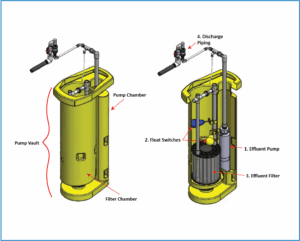
Float switches are responsible for telling the control panel what’s happening inside the tank. Depending on the system configuration, floats may control functions such as:
- Pump operation
- Pump shutoff
- High-water alarm
- Other system control functions
A float problem can sometimes appear to be a panel problem. Inspect the floats for obvious issues such as:
- A float caught against piping or equipment
- Tangled float cords
- Debris restricting movement
- Incorrect float positioning
- Damaged cords
- Loose field wiring
- A float that doesn’t change state when raised or lowered
If the pump operates correctly in manual mode but doesn’t operate automatically, the float circuit is one of the logical places to investigate.
4. Determine Whether the Pump Will Run Manually
If the Stepros control panel is equipped with a manual or HAND operating position, this can be an important diagnostic tool. If the pump runs manually but won’t run automatically, the pump and its power circuit may be functional — troubleshooting can then focus more closely on the automatic control circuit, float switches, and associated wiring.
If the pump won’t operate manually or automatically, investigate items such as:
- Incoming power
- Pump circuit breaker
- Pump wiring
- Pump condition
- Control components
- Overload or protective devices, when applicable
The goal is to isolate the problem instead of replacing components unnecessarily.
5. Check the High-Water Alarm
A high-water alarm doesn’t necessarily mean the alarm circuit has malfunctioned. In many cases, the alarm is doing exactly what it was designed to do — warning that the liquid level has risen above the normal operating range.
If the high-water alarm activates, determine why the level has increased. Possible causes can include:
- Pump not operating
- Float switch problem
- Electrical power loss
- Pump failure
- Blocked or restricted discharge
- Downstream system problem
- Abnormally high incoming flow
Treat the alarm as information first, rather than immediately assuming the alarm itself is defective.
6. Inspect Field Wiring
Control panels are only one part of the complete electrical system. Field wiring connects the panel to the pump, floats, power source, alarm devices, and other equipment — a loose, damaged, or incorrectly terminated field connection can produce symptoms that appear to originate inside the control panel.
Look for:
- Loose terminals
- Damaged conductors
- Corrosion
- Moisture intrusion
- Incorrect field connections
- Damaged underground wiring
- Improper splices
Always compare field wiring with the wiring diagram supplied for the specific Stepros panel.
7. Don’t Replace Parts Until You’ve Isolated the Problem
One of the easiest ways to make troubleshooting more expensive is to start replacing components without determining the cause of the failure. Instead, work through the system logically:
Power → Panel → Controls → Floats → Pump → Discharge System
At each step, verify that the expected input produces the expected output. This approach can help distinguish between a control panel problem and an external system problem.
Information to Have Before Contacting Stepros
If additional technical assistance is needed, gathering some basic information beforehand can make troubleshooting much faster. Whenever possible, have the following available:
- Control panel model or identification information
- Supply voltage
- Pump manufacturer and model
- Pump horsepower
- Description of the problem
- Whether the pump operates manually
- Which alarms or indicator lights are active
- Breaker status
- Float positions
- Photos of the control panel and installation
- Any voltage or electrical measurements already taken
Instead of reporting “the panel doesn’t work,” information such as “the panel has proper incoming voltage, the pump operates in HAND, but it won’t operate automatically when the pump float is raised” gives technical support a much better starting point.
A Systematic Approach Saves Time
Stepros control panels are part of a complete STEP system, which means a problem at the panel isn’t necessarily a problem with the panel. Checking the basics first — incoming power, operating mode, floats, field wiring, pump operation, and alarm conditions — can often identify the source of the problem without unnecessary component replacement.
When additional assistance is required, Stepros, LLC can help technicians work through the system and determine the next appropriate troubleshooting step.
Important: Always refer to the wiring diagram and documentation supplied with the specific Stepros control panel. Panel configurations and system requirements may vary.